Grok Models Explained: What the App Menu, the Rate-Limit Buckets, and the API Rate Card Each Call Them
Grok uses different names in its chat app and developer API. The app menu lists Fast, Build, Auto, Expert and Heavy, while the API rate card lists versioned models such as grok-4.7 and grok-4.6. We checked the app menu and its rate-limit data, then compared those results with xAI’s API pricing table.
The Grok app and the Grok API name models differently, and no official page connects them. In the app, a free account can use Fast (the default) and Build; Auto, Expert and Heavy are gated with “Requires SuperGrok”. Under the hood, our testing showed the Fast option draws from a grok-3 bucket limited to 30 requests per rolling 24 hours, with a separate grok-4 bucket of 7 per 24 hours we never spent. On the API side, the flagship grok-4.7 costs $2 per million input tokens and $6 per million output (doubling for prompts of 200k tokens or more). Grok-4.6 and grok-4.5 list the same $2/$6 short-context rates with cheaper cached input, and grok-4.3 sits below at $1.25/$2.50.
Two naming systems, zero official crosswalk
Open the Grok app and you choose between Fast, Build, Auto, Expert and Heavy. Read the API rate card and you buy grok-4.7, grok-4.6, grok-4.5, grok-4.3. The two lists share no words, and neither xAI’s app nor its docs publish a table connecting them. What we could establish from our own session:
- The app’s Fast option draws its quota from a bucket the rate-limits endpoint calls grok-3 — the only direct menu-to-model link we could verify ourselves.
- We could not verify which API model or backend powers Heavy. The “strongest models” wording on the Ultra row of the plans page may suggest a higher-capability option, but it does not establish a direct mapping.
- Everything else (which backend Auto routes to, what Build runs on) is not published anywhere we looked, and we say so rather than guess.
The app menu, and what a free account can open
The model picker above the chat input shows five options. On our free account, their states were:
| App option | Free account | What it is for |
|---|---|---|
| Fast | Available (default) | Everyday chat; the fastest replies |
| Build | Available | Building things in the app (apps/artifacts); build-specific limits untested |
| Auto | Requires SuperGrok | Routes automatically between modes |
| Expert | Requires SuperGrok | Deeper reasoning mode |
| Heavy | Requires SuperGrok | The top multi-model tier |
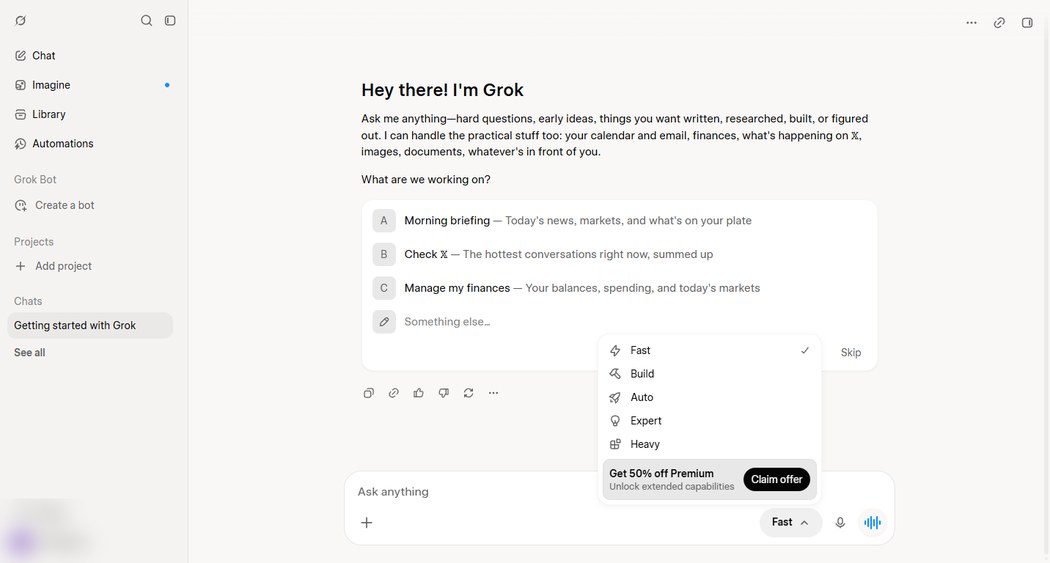
One more free-account detail: the picker bottom carried an upgrade banner (“Get 50% off Premium”), so the menu doubles as a paywall surface.
What the menu draws from: the buckets we measured
Quota on Grok is metered per model bucket, not per account. We verified this by sending messages on Fast and reading the app’s own rate-limits endpoint after each send:
| Bucket (endpoint name) | Limit we observed | How we know |
|---|---|---|
| grok-3 (serves the Fast option) | 30 requests per rolling 24 hours | windowSizeSeconds: 86400, totalQueries: 30; remaining count dropped one per send (3→2→1→0) |
| grok-4 (separate bucket) | 7 requests per 24 hours | Same endpoint, second bucket; showed 7 of 7 all session — we never spent it |
We observed a grok-4 bucket with a limit of 7 requests, but did not use it. We therefore cannot identify which app option draws from it or confirm how its counter changes. We also found that interrupted submissions still used a request from the grok-3 allowance. The full request-by-request log is in our free tier article.
Why one account holds two buckets
The two-bucket structure we measured — grok-3 at 30 per 24 hours, grok-4 at 7 per 24 hours — was the clearest finding of the session. In our testing, the rate-limit endpoint showed separate grok-3 and grok-4 counters, and we confirmed that Fast reduced the grok-3 counter. We did not test the grok-4 counter, so these results do not establish how every app mode is metered. What the session did show:
- Your model choice is a quota choice. On a free account, staying on Fast spends the 30-request pool; the separate grok-4 pool we observed is one-quarter that size (7 requests per 24 hours).
- The two pools refill independently. Draining the Fast bucket did not touch the grok-4 bucket — ours stayed at 7 of 7 all session while Fast went to zero.
- A rolling window, not a midnight reset. With a rolling 24-hour window, an earlier request becomes available again once it falls outside the window. At zero we were told ~23.5 hours remained — not 24:00 sharp.
We verified the per-send accounting only on the grok-3 bucket. Whether the grok-4 bucket decrements the same way, and which menu option would draw on it, is the top item in our follow-up list below.
The API models and their prices
The developer side names models by version and sells them per token. The official rate card, as we captured it (screenshot below), reads:
| API model | Input / per 1M tokens | Output / per 1M tokens |
|---|---|---|
| grok-4.7 (prompt <200k) | $2.00 | $6.00 |
| grok-4.7 (prompt ≥200k) | $4.00 | $12.00 |
| grok-4.6 (prompt <200k) | $2.00 | $6.00 |
| grok-4.5 (prompt <200k) | $2.00 | $6.00 |
| grok-4.3 (prompt <200k) | $1.25 | $2.50 |
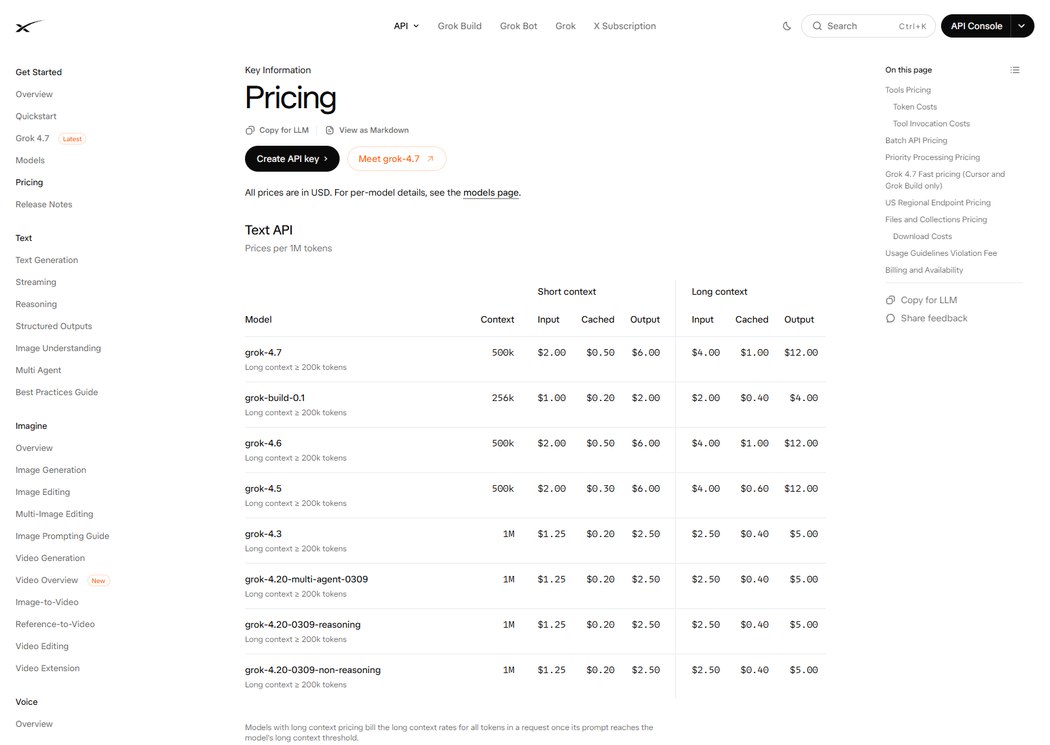
Details that matter when comparing to other providers: at the standard short-context rates, grok-4.7, grok-4.6 and grok-4.5 all list the same $2.00/$6.00 input/output prices — they differ in cached-input rates ($0.50, $0.50 and $0.30 per million respectively) — and grok-4.3 sits below at $1.25/$2.50. Prompts of 200,000 tokens or more double the per-token price on the models that have the split ($4.00/$12.00 for grok-4.7 and grok-4.6, $4.00/$12.00 for grok-4.5, $2.50/$5.00 for grok-4.3); cached input is billed far below fresh input; and batch and priority tiers modify the base rates (Batch −20%, Priority 2x, US-endpoint surcharge 1.1x on some routes). We broke the full math down with a worked example in our Grok API pricing article.
Which model for what
Built only from what we could verify, this is the decision table:
| You want to… | Pick | Why |
|---|---|---|
| Chat on a free account | Fast | The default; the only bucket we measured (30/24h) |
| Build apps/artifacts on a free account | Build | Selectable free; its own limits are untested, so pace yourself |
| Deeper reasoning | Expert / Heavy | Gated “Requires SuperGrok” — not runnable on free, so we claim nothing about their quality |
| Programmatic access | grok-4.7 via API | The flagship on the rate card; $2/$6 per million tokens under 200k |
| Cheap bulk API work | grok-4.3 or cached input | $1.25/$2.50 per million, with cached input billed at $0.20 per million on that model |
What we would verify first with a paid account
So the gaps are explicit, this is our own follow-up list, in order:
- The unlocked menu. One paid subscription shows which of Auto/Expert/Heavy unlock at which tier — the single missing fact the “Requires SuperGrok” label hides.
- The grok-4 bucket in use. Spend it, confirm the decrement pattern matches grok-3’s, and identify which app option reaches it.
- Build’s quota. Exhaust a Build session and read the endpoint’s build-specific limits, which the pricing page only calls “Limited”.
- Quality, not just names. Run the same three-question test across Fast and the paid modes, the way our ChatGPT vs Claude comparison does across providers.
If and when we run these, this page gets updated with dated results — not estimates.
What we could not test
We never ran Auto, Expert or Heavy — they are paywalled on free accounts, and we did not pay. So this page intentionally contains no quality comparison, no speed numbers, and no claims about which backend the app options route to beyond the one bucket link we verified. Build’s own quota was not exhausted either. If we subscribe later, this page gets updated with the unlocked menu and real usage numbers.
Frequently asked questions
- What models does Grok have?
- In the app: Fast, Build, Auto, Expert and Heavy, with the last three gated behind a paid plan. On the API: grok-4.7, grok-4.6, grok-4.5 and grok-4.3 per the official rate card. The two naming systems are not officially cross-referenced anywhere we could find.
- Does the free account show a grok-4 rate-limit bucket?
- In our test, the endpoint displayed a separate grok-4 bucket with a limit of 7 requests per 24 hours, alongside the 30-per-24-hour grok-3 bucket that serves the Fast option. We did not use it or identify which app option accesses it, so this does not confirm that users can directly select grok-4 in the app.
- What model does Grok use by default?
- Fast. It is the preselected option in the picker, and our testing confirmed it draws quota from the grok-3 bucket (30 requests per rolling 24 hours on a free account).
- What is the difference between Fast and Expert in Grok?
- Fast is the default everyday model, available free. Expert is a deeper-reasoning option that the app gates with 'Requires SuperGrok'. We could not run Expert on a free account, so we make no claims about its output quality or speed.
- How much does grok-4.7 cost?
- $2 per million input tokens and $6 per million output tokens for prompts under 200k tokens; the rates double for prompts of 200k or more. Cached input is billed at a lower rate. Source: xAI's official rate card, checked 5 November 2026.
Sources and what we could not test
| Claim | Where it came from | Date checked |
|---|---|---|
| App menu: Fast/Build available free; Auto/Expert/Heavy 'Requires SuperGrok' | model picker on our free account (screenshot above) | 5 Nov 2026 |
| grok-3 bucket 30 req/rolling 24h; grok-4 bucket 7 req/24h (observed, unspent) | our own account, grok.com /rest/rate-limits endpoint read between sends | 5 Nov 2026 |
| API prices: grok-4.7 $2/$6 (<200k), doubling at 200k; grok-4.3 $1.25/$2.50; cached-input rates | official xAI rate card (screenshot above) | 5 Nov 2026 |
| Gating label wording and free-tier model availability | x.ai/pricing plan descriptions | 5 Nov 2026 |
We never ran Auto, Expert or Heavy (paywalled on free accounts), so nothing on this page describes their behavior, speed or quality. The grok-4 bucket was observed but never spent. Build's own quota was not exhausted. The app-menu-to-API crosswalk beyond Fast/grok-3 is not established.